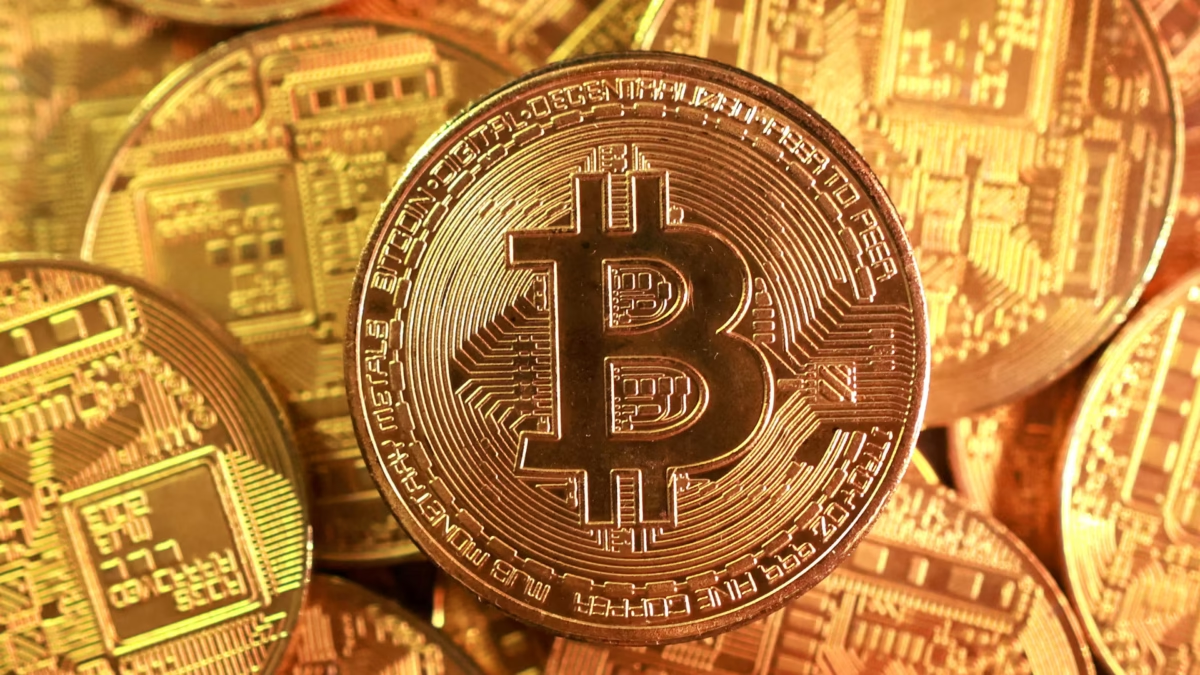
Bitcoin is the world’s first and largest cryptocurrency: a form of digital money that runs on a global network of computers instead of being issued by a government or controlled by a bank. It lets people send value directly to one another over the internet, without a middleman in the middle taking a cut or deciding whether the payment is allowed.
That is the one-sentence version. But if you have landed here, you probably want to understand what that actually means, whether it is safe, and why anyone cares. This guide walks through it in plain English, with no hype and no jargon left unexplained.
Bitcoin in one minute
At its simplest, Bitcoin is two things at once. It is a currency (the coins, written as BTC), and it is the network those coins move across (the Bitcoin blockchain). When people say they “own Bitcoin,” they own a balance recorded on that shared network, which they control with a private digital key.
Three features make it different from the money in your bank account:
- No central controller. No company, bank, or government runs Bitcoin. The network is maintained by thousands of independent computers around the world, so no single party can freeze it, print more of it, or shut it down.
- A fixed supply. There will only ever be 21 million bitcoins. This cap is written into the software and cannot be changed on a whim, which is why supporters compare it to digital gold.
- Open and borderless. Anyone with an internet connection can use it. A payment to someone on the other side of the world settles the same way as a payment next door.
Where Bitcoin came from
Bitcoin was introduced in a nine-page document, called a whitepaper, published in October 2008 under the name Satoshi Nakamoto. To this day, no one knows for certain who Satoshi is, or whether it was one person or a group. The first bitcoins were created in January 2009, in the depths of the global financial crisis, and the early software carried a pointed reference to bank bailouts. The idea was a form of money that did not depend on trusting banks or governments to behave.
How does Bitcoin actually work?
This is where most explainers lose people, so we will keep it grounded. Three pieces do the work.
The blockchain: a shared record book
Imagine a public notebook that lists every Bitcoin transaction ever made. Everyone on the network holds an identical copy, and new transactions are added in batches called blocks, one roughly every ten minutes. Because thousands of copies exist and they must all agree, no one can quietly edit the record to fake a balance or spend the same coin twice. This shared record book is the blockchain.
Mining: how transactions get confirmed
New transactions need to be checked and added to the record. This job is done by computers called miners, which compete to solve a hard mathematical puzzle. The winner adds the next block and earns newly created bitcoins as a reward. This process, called mining, is what secures the network and slowly releases new coins into circulation. It also uses a lot of electricity, which is one of the most common and legitimate criticisms of Bitcoin.
Keys and wallets: how you control your coins
Your bitcoins are controlled by a private key, a secret string that proves the coins are yours. You keep this key in a wallet, which can be an app, a website, or a small physical device. Whoever holds the key controls the coins, which leads to the single most important rule in all of crypto: if someone else gets your key, they can take everything, and if you lose it, no one can recover it for you. There is no bank to call and no password reset.
Why only 21 million? The supply cap explained
Traditional currencies can be printed in unlimited amounts, which gradually erodes their value through inflation. Bitcoin was designed to do the opposite. Its supply is capped at 21 million coins, and the rate at which new coins are created is cut in half roughly every four years, in an event called the halving. The most recent halving, in April 2024, reduced the reward for mining a block from 6.25 to 3.125 bitcoins.
As of early 2026, more than 19.9 million bitcoins have already been mined, which is over 95 percent of the total that will ever exist. The final coins are not expected to be mined until around the year 2140. This built-in scarcity is central to the investment case supporters make for Bitcoin, though scarcity alone does not guarantee a rising price.
What is Bitcoin actually used for?
In practice, people use Bitcoin in a few main ways:
- As an investment or store of value. This is the most common reason today. Many buyers treat it as “digital gold,” a scarce asset they hold for the long term rather than spend.
- As a way to move money. Bitcoin can send value across borders without a bank, which is useful in places with unstable currencies or limited banking.
- As a payment method. A growing but still small number of merchants accept it directly, though its price swings make it less practical for everyday spending.
Is Bitcoin safe? An honest answer
This deserves a straight answer, because “safe” means two different things.
The network itself is highly secure. The Bitcoin blockchain has run continuously since 2009 and has never been successfully hacked at the protocol level. The technology has earned its trust.
Your money is not automatically safe, though. The risks sit around Bitcoin, not in it. The price is highly volatile and can fall sharply. If you lose your private key, your coins are gone for good. And the space is full of scams that target newcomers, from fake giveaways to “guaranteed return” schemes and bogus support staff asking for your key. A genuine rule of thumb: no legitimate person or service will ever ask for your private key or seed phrase, and anything promising guaranteed profits is a red flag.
The honest summary is that Bitcoin the technology is robust, but Bitcoin the investment carries real risk, and protecting your own coins is entirely your responsibility.
Should you buy Bitcoin?
That is not a question anyone can answer for you, and be wary of anyone who claims otherwise. Bitcoin has produced dramatic gains over its history and equally dramatic crashes along the way. It can rise or fall by double digits in a single day. Whether it belongs in your portfolio depends on your own goals, your timeline, and how much volatility you can genuinely stomach.
What matters most before you buy anything is understanding what you are buying and doing your own research rather than acting on hype or a tip from social media. If you do decide to start, most people begin with a small amount on a reputable exchange, and learn how to store it safely before committing more.
The bottom line
Bitcoin is digital money secured by a global network rather than a bank, with a fixed supply of 21 million coins and a track record stretching back to 2009. It is genuinely innovative technology and the foundation the entire crypto market is built on. It is also volatile, irreversible, and surrounded by scams, which makes understanding it, exactly what you are doing right now, the most valuable first step any investor can take.