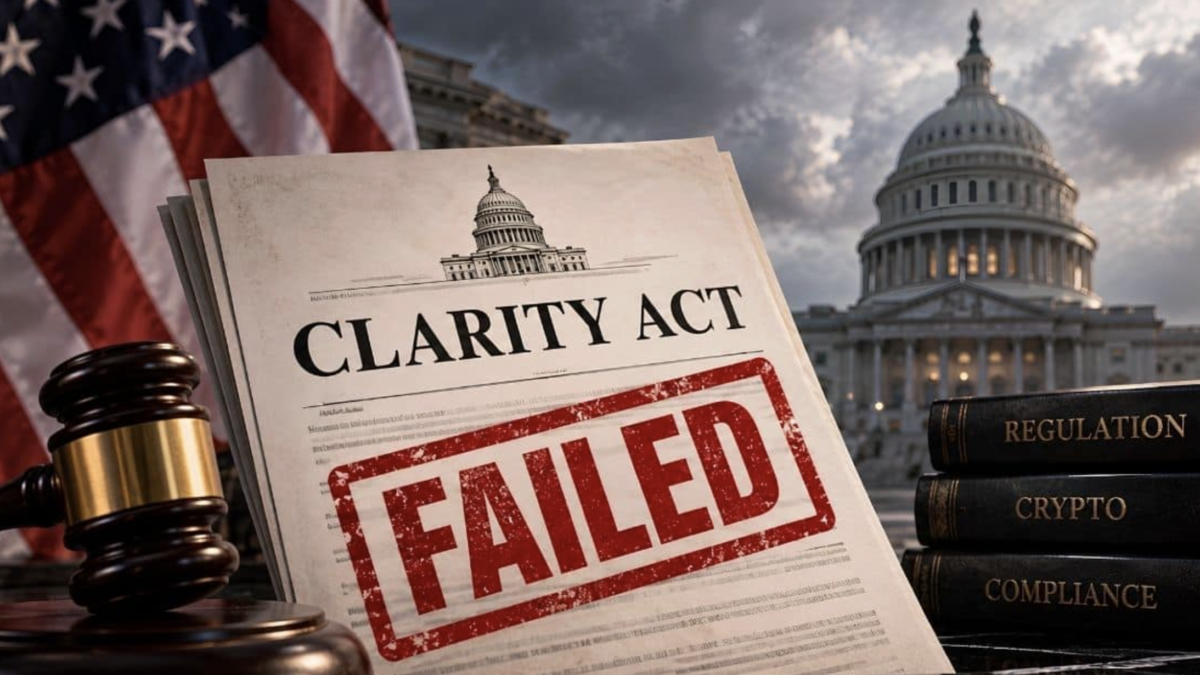
The Digital Asset Market Clarity Act failed to clear the US Senate on Tuesday afternoon, falling eleven votes short of the 60 needed to advance it to debate.
Senators voted 49 in favour and 50 against on the cloture motion for H.R. 3633. A failed cloture vote effectively ends the bill’s chances this year, with roughly 22 working days left on the Senate calendar before midterm campaigning takes over.
What the Final Forty-Eight Hours Bought
Republicans spent the weekend conceding.
The Associated Press reported on Sunday that President Donald Trump had agreed to about 80% of a bipartisan ethics proposal from senators Thom Tillis and Ruben Gallego, requiring officials with a significant financial interest in a crypto issuer to divest it or place it in a blind trust. A revised 630-page draft followed late on Sunday night, softening the developer-liability language that had worried software builders and handing state attorneys general a role in enforcing the new ethics rules.
That last concession is worth dwelling on, because of what happened next.
On Monday, eighteen state attorneys general wrote to the Senate Banking Committee urging a no vote. Their objection was not to the ethics provisions they had just been asked to enforce. It was that other parts of the bill would weaken their existing authority to prosecute crypto fraud, an authority they said had produced more than 330 enforcement actions since 2017.
So the offer aimed at winning Democratic votes handed a new job to a group that spent the following day arguing the bill should not pass. Neither concession moved the seven Democrats Republicans needed.
The Three Fights That Never Closed
Senator Cynthia Lummis, the bill’s lead Republican negotiator, argued before the vote that her side had already delivered more than 120 of the changes Democrats had asked for over the past year.
‘It’s now or never for the Clarity Act,’ she wrote, pointing to what she called a historic ethics agreement covering the president, vice president, Congress and federal judges.
Senate Banking ranking member Elizabeth Warren delivered a floor speech opposing the bill, warning it would produce a ‘crypto-fueled economic crash’ if approved. Her party followed her.
Three disputes had dragged on for months and none fully closed. Banks wanted language barring crypto firms from paying yield on stablecoins, arguing it would pull deposits out of traditional accounts, and eight banking trade groups pressed for tighter restrictions days before the vote. Democrats wanted stronger conflict-of-interest rules, given the president’s personal crypto holdings. Software developers wanted explicit protection from criminal liability for building non-custodial tools.
The Market Had Already Decided
Bitcoin fell, but the shape of the fall is more interesting than the size.
It traded as high as $77,200 shortly before proceedings began, then broke down around 2:30pm Eastern, sliding to a session low near $75,600 in roughly ten minutes as the no tally climbed past 40. It was trading around $76,000 later in the session, down close to 4% on the day and well below its September peak near $82,000. The wider crypto market lost close to 3%, having briefly been down more than 4%.
That reads dramatic until you look at what was already priced. Odds on Polymarket that the Clarity Act would become law in 2026 had fallen to 17% by Tuesday morning, from around 34% the day before, after Republicans rejected a Democratic counteroffer hours before the vote.
In other words, the market had halved its expectations before a single vote was cast. What happened at 2:30pm was confirmation, not surprise, which is why an orderly slide rather than a rush for the exits.
What Is Actually Left
The industry response was defiant rather than resigned. The Digital Chamber, a trade group, called the result a setback rather than a defeat and said it would keep pushing for passage.
But the calendar is the constraint. With around three weeks of working days before the fall session gives way to campaigning, and no obvious room left to negotiate on language that has already absorbed 120 changes, the legislative route for 2026 is effectively closed.
That leaves rulemaking by the Securities and Exchange Commission and the Commodity Futures Trading Commission, the fallback Treasury Secretary Scott Bessent has pointed to if legislation stalled. It is slower, narrower and reversible by a future administration in a way a statute is not. For now it is the nearest thing to a regulatory timeline US crypto markets have.