DefiLlama has begun publishing letter grades for crypto tokens, running from AAA down to CCC. Of 149 tokens listed, 128 now carry a score. Exactly one of them is rated AAA.
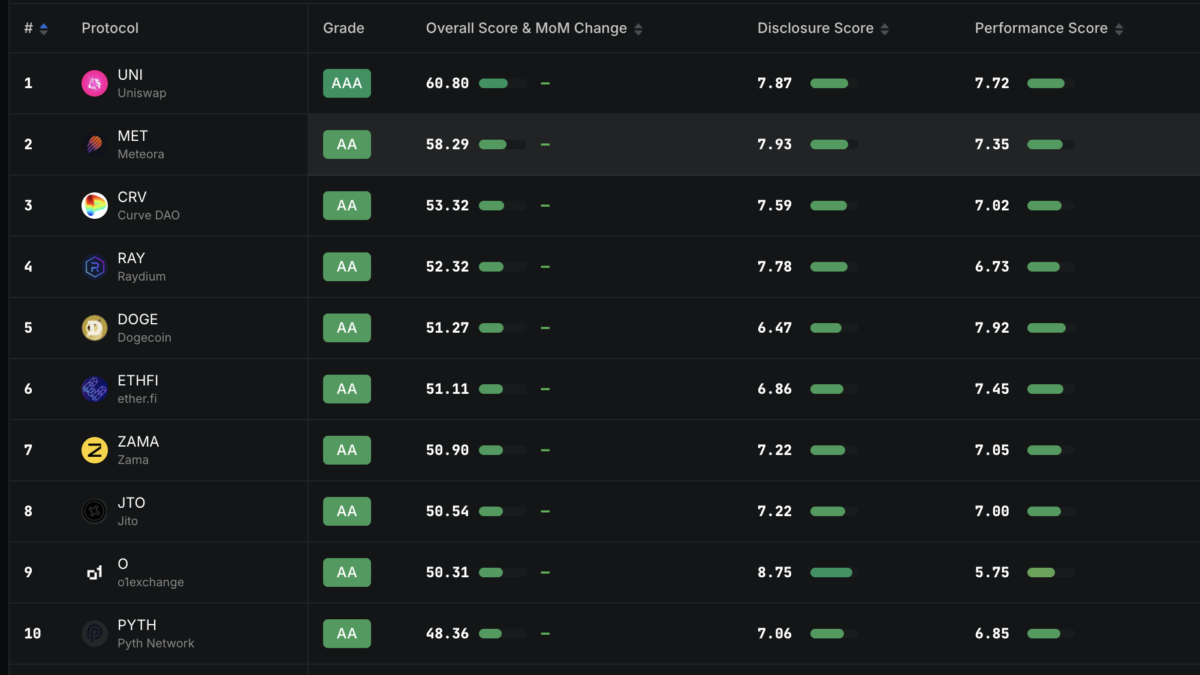
That token is Uniswap, at 60.80 out of 100. Second place, Meteora, sits at 58.29. The gap between the top of the table and a grade nobody else can reach is under two and a half points.
How a Token Gets Its Grade
Each token receives two scores out of ten. One covers disclosure: what the project has published about its tokenomics, insider wallets and commercial arrangements. The other covers market performance: liquidity, spreads, how many venues list it, and how its market makers behave.
The two are then multiplied rather than averaged. Multiply Meteora’s 7.93 disclosure by its 7.35 performance and you get 58.28, against a published 58.29. Uniswap’s 7.87 and 7.72 produce 60.80.
That single design choice is what makes the table worth reading. Under an average, a project scoring 10 on disclosure and 2 on the market could post a respectable 6 out of 10. Multiplied, it scores 20 out of 100. Strength on one axis cannot paper over failure on the other.
The grade bands are visible in the data. The only AAA sits at 60.80. Every AA falls between 40.34 and 58.29. A grades start below 38.76. To reach AAA a token needs roughly six or better on both halves, and almost nothing manages it.
The Table Has a Pattern
Read down the leaderboard and the same shape repeats. Among the 100 highest-ranked tokens, 41 score below five out of ten on disclosure. Only five score below five on market performance. Seventy-five of the hundred score higher on performance than on disclosure, and the median scores are 6.35 against 5.26.
Thirty-four of those hundred tokens combine a disclosure score under five with a performance score above six. That is a specific and unflattering profile: assets that trade perfectly well and tell you very little.
Hyperliquid is the clearest case. At roughly $81 billion fully diluted it is one of the largest assets on the board, and it ranks 90th with a BB. Its market performance scores 6.65. Its disclosure scores 3.80. Pump.fun scores 7.28 on performance and 3.69 on disclosure. Sei posts 6.90 and 3.69. Pudgy Penguins manages 7.45 and 3.75.
Deep books and tight spreads are not what crypto is short of. Documentation is.
Disclosure Alone Does Not Save You
The multiplication cuts the other way too, which is what stops the score becoming a paperwork exercise.
Saffron has the sort of disclosure score that would carry it into the top twenty on that axis alone, at 6.80. Its market performance is 3.17. It sits 99th with a B. Turtle discloses at 8.39, better than Uniswap, and still ranks 23rd because its performance is 4.90. o1exchange posts the strongest disclosure score in the top hundred at 8.75 and finishes ninth.
A project can publish everything and still fail, if nobody is trading it properly.
What the Score Does Not Cover
The obvious risk with a letter grade is that people read it as a safety rating. DefiLlama’s own note under the table is explicit that the score assesses disclosure quality and token market structure, and should not be taken as an assessment of expected returns or as an investment recommendation.
That distinction matters more than it sounds. A high grade describes what a token looks like right now, on two specific measures. It says nothing about whether the code is secure, whether governance will hold, or what the price does next. The largest losses in crypto have come from exploits and collapses that a liquidity score would never have caught.
What the table does offer, and what has not really existed before in public, is a free and consistent way to ask one useful question about any listed token: does what this project says about itself match what its market actually does? For most of the 128, the answer is that the market looks a good deal better than the paperwork.